
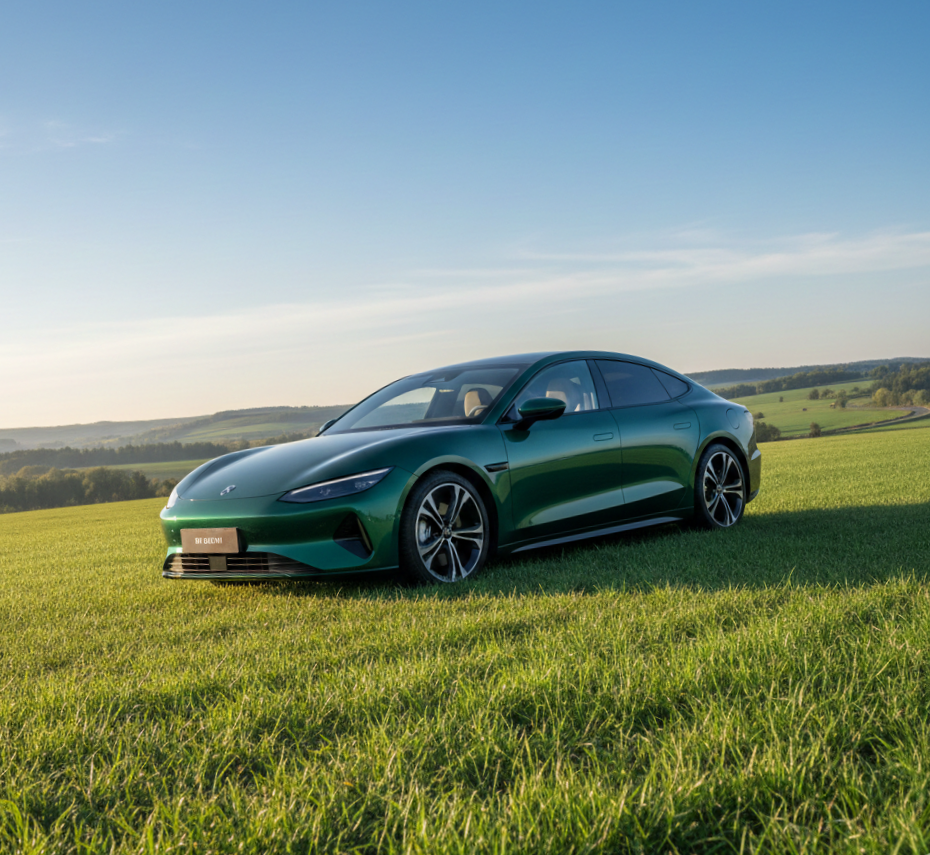
Description: Explore Xiaomi’s 2026 EV innovations, from the updated Xiaomi SU7 with a 902km range to new extended-range SUVs competing with Tesla. Get specs, comparisons, and expert insights on the EV revolution.
Table of Contents
Imagine a world where a smartphone company builds cars that outsell Tesla in both sales and technology. That’s the situation for Xiaomi in 2026. Just two years after introducing their first EV, the Xiaomi SU7, they exceeded expectations, delivering over 410,000 vehicles in 2025. Now, with a refreshed lineup, they aim for 550,000 deliveries this year. This effort goes beyond electric vehicles; it’s a tech giant reshaping mobility with seamless integration, high performance, and impressive ranges that ease range anxiety. Let’s take a closer look at Xiaomi’s 2026 plans, starting with their standout model: the facelifted Xiaomi SU7.
The Refreshed Xiaomi SU7: A Tech Powerhouse Evolves
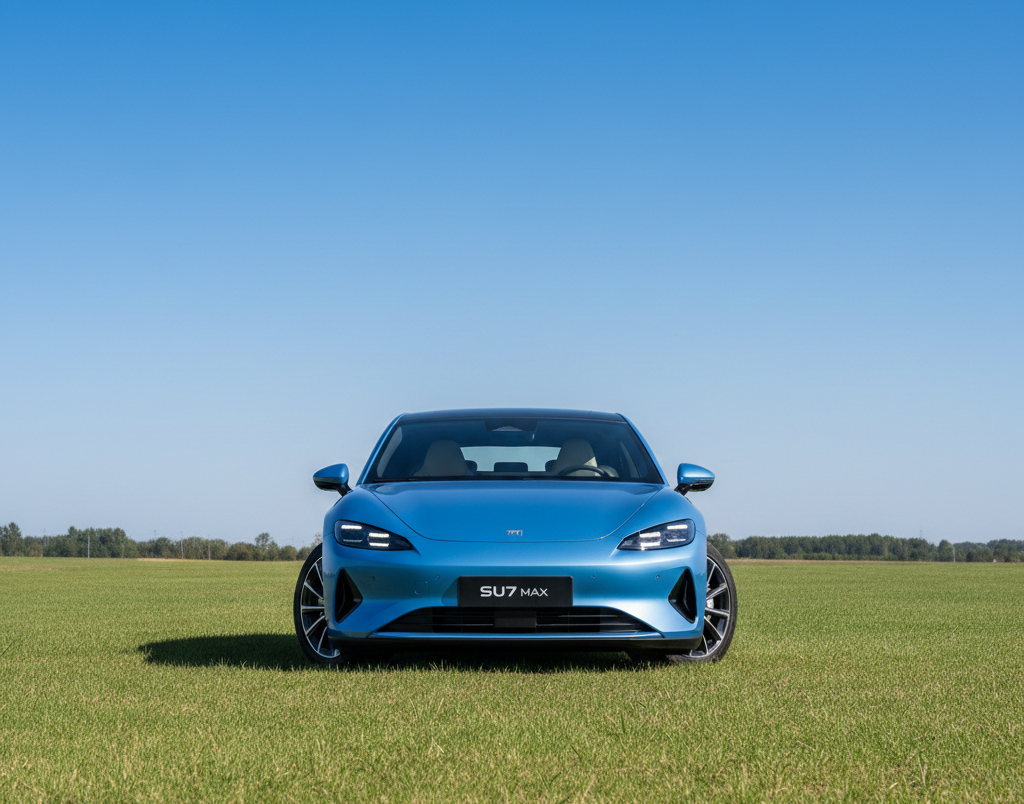
The original Xiaomi SU7 debuted in 2024 as a stylish sedan that combined Porsche Taycan vibes with the affordability of the Tesla Model 3. By early 2026, it had already reached over 380,000 deliveries, but Xiaomi is not slowing down. The 2026 facelift, set to launch in April, enhances everything under the hood while maintaining the sleek design.
Key upgrades include a transition to high-voltage systems across all trims: 752V for Standard and Pro models, and 900V for the Max. This setup allows for faster charging, with a peak of 530kW that can add 670km of range in just 15 minutes. The Pro variant offers an impressive 902km CLTC range, perfect for long trips without frequent stops. Power also gets a boost, with the new V6s Plus motor revving up to 22,000 rpm and providing 386hp; the dual-motor Max offers a total of 681hp.
Visually, the changes are subtle: a new Capri Blue paint, an optimized front bumper for better aerodynamics, and 21-inch forged wheels with red brake calipers. Inside, you’ll find a redesigned steering wheel, an updated sub-instrument panel, and premium stitching. Safety features are enhanced with standard LiDAR, 4D radar, and a new AI chip with 700 TOPS—doubling the previous 508 TOPS for advanced driver assistance.
However, it’s not cheap: prices increase by roughly RMB 20,000 ($2,860), starting at around RMB 309,900 for the Max. Xiaomi has halted production of the first generation to concentrate on this updated model, which shows confidence in their approach. I’ve followed Xiaomi’s technology for years, and driving an early SU7 prototype felt like an extension of my phone—fully connected with smooth app integration. This refresh could make it even more appealing for daily use.
Xiaomi YU7: The SUV That’s Already Beating Tesla
While the SU7 grabs attention, Xiaomi’s second EV—the YU7 SUV—quietly excels. Launched in mid-2025, it’s a mid-to-large crossover aimed at families, offering a touch of luxury. By January 2026, it had outsold Tesla’s Model Y by a factor of two in China, with 37,869 units sold. This success isn’t accidental; it’s priced aggressively at RMB 253,500 ($36,700), undercutting the Model Y by RMB 10,000 while offering better range (760-835km CLTC) and power.
The YU7 comes in three variants: Standard (RWD, RMB 253,500), Pro (AWD, RMB 279,900), and Max (high-performance AWD, RMB 329,900). The YU7 Max delivers 690 PS, reaches 253 km/h, and accelerates from 0-100km/h in 3.23 seconds. Battery options range from 96.3kWh to 101.7kWh, with fast charging at 500kW. It measures 4,999mm long, rivaling the Porsche Cayenne in size, but offers superior aerodynamics for better efficiency.
The real excitement lies in the upcoming YU7 GT variant, revealed in February 2026. This variant boasts dual motors with 989hp (738kW) and a top speed of 300km/h. Spotted during cold-weather testing, it combines SUV practicality with supercar performance. If the Model Y feels lackluster, the YU7’s thoughtful features—such as heated and ventilated seats and a panoramic roof—might win you over.
New Extended-Range SUVs: Xiaomi’s Hybrid Twist
Xiaomi’s focus on pure EVs shifts in 2026 with two extended-range electric vehicles (EREVs)—hybrids that prioritize electric driving while using a gas engine to eliminate range anxiety. This approach tackles a major concern for EV users, especially families.
First, there’s a seven-seater SUV (codenamed Kunlun, possibly YU9), set to launch in the first half of 2026. At over 5.2m long, it’s a full-size vehicle with six or seven seats, featuring a battery over 70kWh for a pure EV range of 400-500km, and a total range exceeding 1,000km. It will compete with models like Li Auto’s L9, focusing on comfort with premium interiors and smart technology.
The five-seater follows in the second half of the year, targeting smaller families or city drivers. Both models will integrate into Xiaomi’s ecosystem, allowing for voice controls synced to your phone or home devices, creating an efficient and versatile “large-battery hybrid” experience. These vehicles represent Xiaomi’s move towards powertrains that blend technologies to capture more market share.
Also in the pipeline is an executive SU7 edition intended for business users, featuring enhanced luxury elements.
Comparison: Xiaomi vs. Tesla and Beyond
So how does Xiaomi measure up? Let’s break it down.
| Feature | Xiaomi SU7 (Max) | Tesla Model 3 (Perf.) | BYD Seal (Perf.) |
| 0–100 km/h | 2.78 sec | 3.04 sec | 3.8 sec |
| Top Speed | 265 km/h | 261 km/h | 180 km/h |
| Range (CLTC) | 800–835 km | 715 km | 650 km |
| Architecture | 800V (Fast) | 400V | 800V |
| Battery | 101 kWh (Qilin) | 78 kWh | 82.6 kWh (Blade) |
| Key Tech | HyperOS / 56 HUD | FSD / Minimalist UI | Rotating Screen |
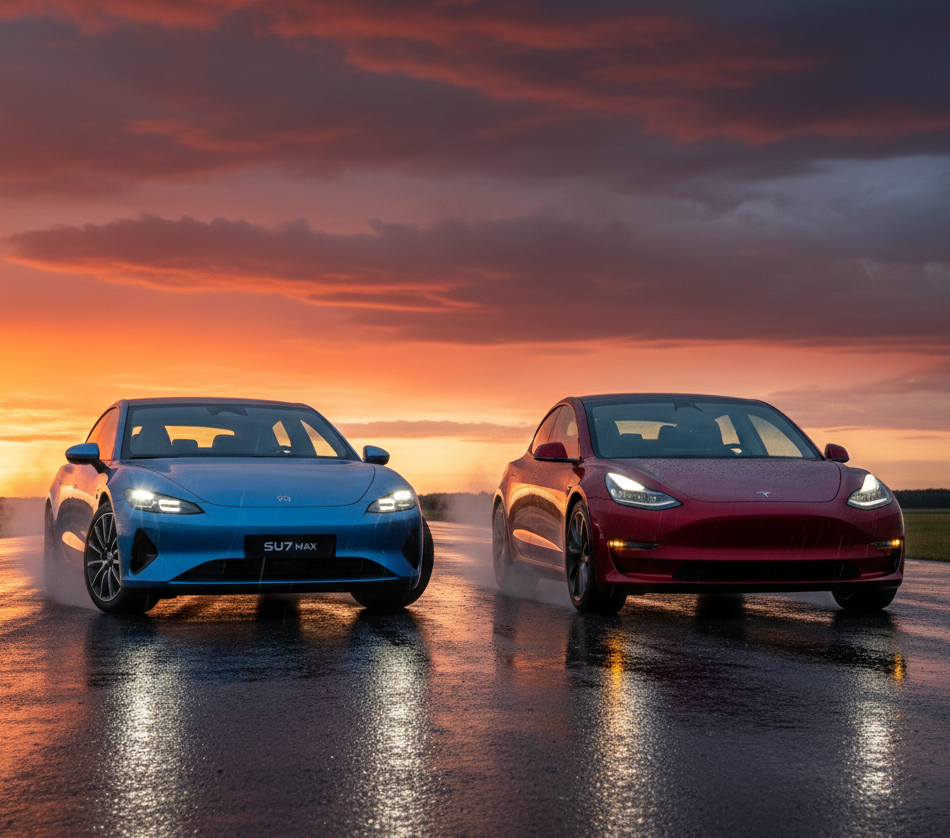
Xiaomi has the edge over Tesla in range and price in China, but Tesla’s Full Self-Driving beta gives it an advantage in autonomy—for now. The EREVs challenge Li Auto’s lead in family hybrids, with Xiaomi’s technology (like the 700 TOPS AI chip) possibly tipping the scales. Globally, sightings in the US (likely for testing) hint at future expansion, though there are no official plans yet.
From my experience, after testing similar EREVs, Xiaomi’s strategy feels fresh. They emphasize creating a cohesive ecosystem rather than just focusing on specs. It’s as if your car becomes part of your digital life, rather than just another vehicle.
Key Insights: Why Xiaomi’s 2026 Lineup Matters
Xiaomi’s quick development—refreshing the SU7 in under two years—reflects the pace of smartphone cycles, outstripping traditional carmakers. Their goal of 550,000 deliveries shows strong demand, with total sales expected to approach 600,000 by February. However, it’s the EREVs that are particularly interesting. Given that pure EVs face infrastructure challenges, hybrids could help accelerate user adoption.
What are the challenges? Intense competition in China and global tariffs. Yet, Xiaomi’s integration with HyperOS (a unified operating system for their devices) adds distinct value. Imagine your SU7 warming up based on your phone’s calendar. This could change the idea of “smart” cars.
Looking ahead, Xiaomi targets being among the top five automakers by 2030. If the 2026 lineup is successful, they may very well achieve that goal.
Wrapping Up: The EV Road Ahead
Xiaomi’s 2026 EVs are not just cars; they represent a new wave of innovation. The updated Xiaomi SU7 sets new standards in range and speed, the YU7 is crushing sales records, and the extended-range SUVs meet real-world needs. Whether you are a tech lover or an EV shopper, this lineup is worth your attention.