
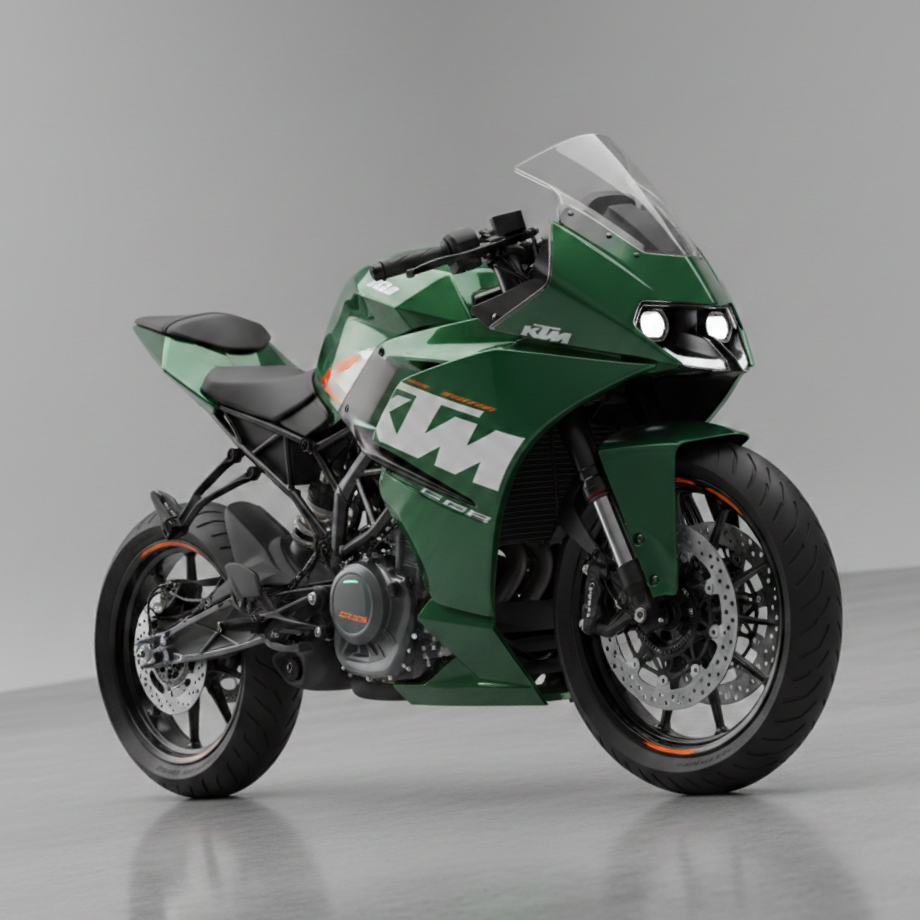
The global sub-500cc supersport motorcycle segment has traditionally served as a critical entry point for enthusiasts transitioning from commuter-class machines to high-performance racing platforms. Within this context, the development of the KTM RC 390 has represented a continuous effort to push the boundaries of single-cylinder performance, balancing the constraints of European A2 licensing with the “Ready to Race” ethos of the Mattighofen brand.
As of the 2026 model year, the machine has undergone a comprehensive transformation, characterized by a fundamental shift in powertrain architecture, an aerodynamic overhaul inspired by MotoGP prototype development, and an electronics suite that rivals flagship liter-class motorcycles. This report examines the technical specifications, design philosophies, and market dynamics surrounding the 2026 iteration, drawing on extensive testing data and industry disclosures to provide a nuanced understanding of its place in the modern motorcycling landscape.
Table of Contents
Technical Architecture of the LC4c Powertrain
The most significant update for the 2026 model year is the transition from the legacy 373.2 cc engine to the newly developed LC4c 398.7 cc architecture. This change is not merely a slight displacement bump but a fundamental redesign of the engine’s internal dimensions and combustion characteristics. By increasing the stroke from 60 mm to 64 mm while maintaining the 89 mm bore, KTM engineers have prioritized torque delivery and mid-range tractability over pure high-rpm screaming. This longer-stroke configuration allows for a more efficient spread of power, addressing one of the primary criticisms of earlier single-cylinder supersports: the lack of low-end “grunt” required for urban navigating and exiting tight corners on the track.
The move to the LC4c platform brings a revised cylinder head design that is more compact and lighter, utilizing double overhead camshafts (DOHC) and four valves to optimize gas exchange. To ensure durability at the high rev limits required of a sportbike, the cam followers are treated with an ultra-hard carbon coating, a technology derived from high-end racing engines that reduces friction and wear. Furthermore, the engine utilizes a ride-by-wire (RBW) throttle system that integrates seamlessly with the Bosch electronic management system, providing a more precise connection between the rider’s input and the engine’s response than mechanical cable-operated systems could ever achieve.
Comparative Performance Metrics of the LC4c Platform
| Performance Parameter | 2026 KTM RC 390 | 2024 KTM RC 390 | Strategic Shift Implications |
| Displacement | 398.7 cc | 373.2 cc | Increased thermal efficiency and torque potential. |
| Maximum Power | 45-46 PS @ 8,500 rpm | 43.5 PS @ 9,000 rpm | Power peaks earlier, improving real-world acceleration. |
| Maximum Torque | 39 Nm @ 6,500-7,000 rpm | 37 Nm @ 7,000 rpm | Higher torque available at lower revs. |
| Bore / Stroke | 89 mm / 64 mm | 89 mm / 60 mm | Shift toward torque-centric engine geometry. |
| Transmission | 6-speed with PASC Slipper | 6-speed with PASC Slipper | Improved clutch-assist for smoother downshifts. |
| Airbox Volume | 40% Increase | Baseline | Enhanced breathing for Euro 5+ compliance. |
The technical data demonstrates that while the peak power increase is modest at approximately 2.5 PS, the delivery is substantially more accessible. Reaching peak power 500 rpm earlier in the rev range allows the KTM RC 390 to sustain higher average speeds through sections where gear changes might otherwise be necessary. This is complemented by a 40% larger airbox, which provides the volume necessary for the engine to breathe effectively under the restrictive parameters of Euro 5+ emissions standards without sacrificing the “hard-hitting” power delivery characteristic of the brand.
Aerodynamic and Aesthetic Transformation
The visual identity of the 2026 KTM RC 390 is a stark departure from the “bubble” fairing era, moving toward a cohesive, race-inspired silhouette that draws heavily from the RC16 MotoGP prototype and the limited-production RC 8C. The redesign centers on a single-piece front fairing that houses a center-set projector LED headlight, flanked by integrated LED positioning lights. This configuration is not merely for aesthetics; it is the result of intensive wind-tunnel testing aimed at reducing drag and improving top-speed stability.
Aerodynamic efficiency is critical in the sub-500cc class, where power-to-weight ratios are strictly capped. The new bodywork is claimed to increase the top speed by approximately 7 mph purely through aerodynamic optimization, a significant gain for a machine with less than 50 horsepower. This efficiency is further enhanced by a new curved radiator and large side vents designed to manage the high thermal loads of the high-compression single-cylinder engine. The fairing effectively channels heat away from the rider while smoothing the airflow around the cockpit, providing class-leading wind protection that reduces fatigue during high-speed track sessions or highway commutes.
The ergonomics have also been refined to suit a wider variety of riders. The clip-on handlebars now feature a 10 mm height adjustment, allowing for a more committed tuck for track use or a slightly more upright position for street riding. The fuel tank has been reshaped to offer better knee-grip, facilitating more precise body-positioning during aggressive cornering. Furthermore, the seat foam thickness has been doubled compared to the first-generation models, and a new high-grip cover helps keep the rider in place during rapid transitions.
Chassis Dynamics and Mass Optimization
KTM’s philosophy of “Ready to Race” is most evident in the chassis and suspension components of the KTM RC 390. The 2026 model retains the characteristic steel trellis frame but features revised lateral rigidity to improve feedback from the front end. A major innovation in this generation is the reduction of unsprung mass, achieved through an entirely new wheel and brake rotor design. By adopting “open-hub” wheels, KTM has saved 7.5 pounds (3.4 kg) of weight in the most critical areas of the machine.
Unsprung mass reduction has a multiplicative effect on handling; by reducing the rotational inertia of the wheels, the motorcycle becomes significantly easier to tip into corners and more stable during rapid direction changes. This is supported by the WP APEX suspension, which remains the gold standard for the class. The 43 mm open-cartridge front fork offers 30 clicks of compression and rebound adjustment, allowing riders to fine-tune the damping to suit specific track conditions or rider weights. The rear suspension utilizes a WP APEX monoshock with preload and rebound adjustability, ensuring that the rear tire maintains optimal contact with the tarmac even under the stress of aggressive acceleration.
Chassis and Suspension Specifications
| Component | Specification | Features |
| Frame | Tubular Steel Trellis | Bolt-on subframe for easier race repair. |
| Front Fork | WP APEX 43 mm | Adjustable Compression & Rebound (30 Clicks). |
| Rear Shock | WP APEX Separate Piston | Preload & Rebound Adjustable. |
| Front Brake | 320 mm Disc | ByBre 4-Piston Radial Caliper. |
| Rear Brake | 240 mm Disc | ByBre Twin-Piston Caliper (Upgraded from 230 mm). |
| Weight (Wet) | 165 kg | 7.5 lb reduction in unsprung mass. |
| Wheelbase | 1,340 – 1,357 mm | Optimized for high-speed stability and flickability. |
The braking system has also seen significant upgrades. The front 320 mm disc is now grabbed by a radially mounted ByBre four-piston caliper, while the rear disc has been increased to 240 mm to provide better control during mid-corner adjustments. These components are governed by a sophisticated electronic system that represents a significant leap forward for the segment.
Digital Integration and Rider Assistance Systems
The electronics package of the 2026 KTM RC 390 is perhaps its most compelling feature, bridging the gap between small-displacement machines and super-naked or superbike categories. The center of this system is a 5-inch bonded glass TFT display that provides a high-resolution interface for all vehicle functions. Unlike older non-bonded displays, this unit is designed to be anti-reflective and anti-fingerprint, remaining legible even in direct sunlight or under heavy glare.
Navigation through the immersive menu system is handled by a new backlit 4-way switch cube on the left handlebar, which allows riders to toggle through ride modes and connectivity options without taking their eyes off the road. The HMI (Human-Machine Interface) is further enhanced by the KTM MyRide app, which enables turn-by-turn navigation, music controls, and incoming call alerts directly on the dashboard.
Advanced Rider Aids and IMU-Based Logic
The inclusion of a 3D inertial measurement unit (IMU) allows for a level of precision in electronic intervention previously unheard of in this class. This sensor data is utilized to enable:
- Cornering ABS: By monitoring lean angle and pitch, the system can modulate braking pressure to prevent low-sides when braking deep into a corner.
- Lean-Sensitive Traction Control (MTC): MTC reacts in milliseconds to rear-wheel slip, adjusting power delivery based on the bike’s lean angle to ensure maximum traction at all times.
- Supermoto ABS: A specialized mode that allows for deactivation of ABS on the rear wheel, facilitating the “backing it in” technique often used by advanced track riders to set up for a corner.
- Launch Control: For the first time, the KTM RC 390 features a dedicated launch control mode that holds the engine at a precise 7,000 rpm until the clutch is released, ensuring perfect starts every time.
- Quickshifter+: A bi-directional system that enables clutchless upshifts and downshifts. By cutting ignition and unloading the gearbox automatically, it allows for seamless acceleration and more stable entry into corners.
The integration of these systems is not merely for safety; it is designed to enhance the “hooligan” spirit of the machine while providing a safety net that allows riders to explore the limits of the motorcycle with greater confidence.
Market Positioning and Competitive Analysis
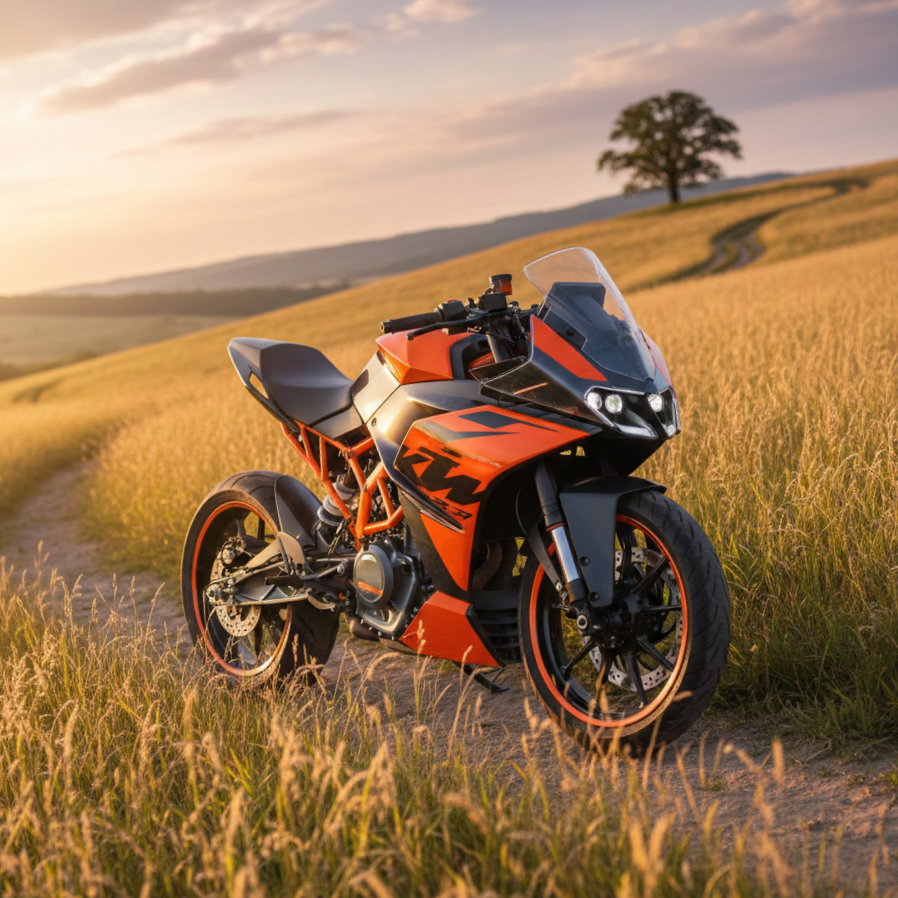
The market for sub-500cc sportbikes has become increasingly crowded, with new entrants such as the Aprilia RS 457 and the Kawasaki Ninja 500 challenging the KTM RC 390’s dominance. KTM has positioned the RC 390 as the most technologically advanced and track-focused option in the segment, catering to a demographic that values chassis dynamics and electronic sophistication over the theoretical refinement of a twin-cylinder engine.
Benchmarking Against Direct Competitors
| Metric | KTM RC 390 (2026) | Aprilia RS 457 | Kawasaki Ninja 500 |
| Engine Type | 399cc Single-Cyl | 457cc Parallel-Twin | 451cc Parallel-Twin |
| Peak Power | 45-46 PS | 47.6 PS | 45.4 PS |
| Peak Torque | 39 Nm | 43.5 Nm | 42.6 Nm |
| Front Suspension | Adj. USD Fork (WP) | Adj. USD Fork (41mm) | Telescopic Fork |
| Electronics | Cornering ABS/TC, Launch Control, QS+ | TC, Riding Modes, Optional QS | Basic ABS, LCD Display |
| Kerb Weight | 165-172 kg | 175 kg | 171 kg |
| Est. Price (India) | ₹ 3.50 Lakh | ₹ 4.10-4.26 Lakh | ₹ 5.24-5.29 Lakh |
The competitive analysis reveals a clear strategic divide. The Japanese twins (Kawasaki Ninja 500 and Yamaha R3) prioritize reliability and a more traditional, perhaps “boring,” aesthetic, often lacking the high-end suspension and electronic aids found on European models. The Aprilia RS 457 is the KTM’s most direct rival, offering a more powerful parallel-twin engine and a raspy, 270-degree firing order that mimics the sound of larger V-twin or cross-plane engines. However, the KTM RC 390 remains more affordable than the Aprilia and significantly cheaper than the Kawasaki, making it a superior value-for-money (VFM) proposition.
KTM’s manufacturing partnership with Bajaj Auto in India is a critical factor in this pricing strategy. By producing the KTM RC 390 in the Chakan plant near Pune, KTM leverages a cost-efficient manufacturing base while maintaining global quality standards. This allow the brand to offer features like adjustable WP suspension and a comprehensive electronics suite at a price point that rivals struggle to match.
Track Performance and Real-World Evaluation
Technical specifications and feature lists provide an essential baseline, but the true value of a motorcycle is realized through its dynamic performance. Evaluated in both track and urban environments, the 2026 KTM RC 390 demonstrates a level of maturity that was absent in earlier iterations. The primary criticism of the first-generation models—excessive vibration and a “strangled” exhaust note—has been largely addressed by the LC4c engine’s refined mapping and improved counterbalancing.
Dynamic Handling and Suspension Performance
On the track, the reduction in unsprung mass translates to a machine that feels nearly “effortless” during direction changes. The RC 390 allows for incredibly late braking, with the IMU-based Cornering ABS providing a safety net that encourages riders to explore deeper lean angles than they might on a less sophisticated machine. While some reviewers have noted that the stock suspension can feel “soft” for the heaviest or most aggressive track enthusiasts, the high degree of adjustability allows for most riders to find a setup that balances comfort with track-level firmness.
The Quickshifter+ system is an essential component of the track experience. By enabling clutchless downshifts, it prevents the rear wheel from hopping or losing traction during aggressive deceleration, a common issue on lightweight singles with high engine-braking. This is further mitigated by the Power-Assisted Slipper Clutch (PASC), which prevents back-torque from upsetting the chassis during rapid downshifting.
Urban Utility and Daily Riding
Despite its aggressive, Moto3-inspired posture, the KTM RC 390 remains a surprisingly viable daily driver. The ride-by-wire throttle provides smooth fueling at low speeds, and the revised airbox design ensures that the engine does not “chug” or feel hesitant below 6,000 rpm. The inclusion of a 13.7-liter fuel tank gives the machine a usable range for longer weekend rides, and the redesigned seats provide enough comfort for several hours of riding without the “plank-like” feel of early generation KTMs.
However, the “committed” ergonomics do remain a factor. Taller riders may find the seating position cramped after extended periods, and the high-revving nature of the single-cylinder engine means that it is happiest when pushed toward the redline, rather than idling through heavy traffic. These are known trade-offs for a machine that prioritizes track-splitting accuracy over touring comfort.
The PowerParts Ecosystem and Customization
KTM’s business model is uniquely intertwined with its PowerParts catalog, which allows owners to take their KTM RC 390 as far as their bank account allows toward a professional racing specification. The 2026 catalog includes a variety of performance upgrades designed for the track:
- Adjustable Rearsets: CNC-machined kits that allow riders to move the footpegs even higher for increased lean-angle clearance.
- Race Exhaust Systems: Including Akrapovič slip-on units that further reduce weight and improve the engine’s power profile.
- Engine Protection: Including crash bars and slider pads that protect the trellis frame and engine casings during track spills.
- Suspension Internals: Advanced WP PRO components that can replace the standard APEX internals for professional-level damping performance.
This ecosystem not only enhances the performance of the machine but also fosters a sense of community and long-term engagement among KTM owners. It is a key factor in the high resale value of the RC 390, as used examples often come equipped with thousands of dollars in performance upgrades.
Production Realities and Global Strategy
The development and launch of the 2026 KTM RC 390 have taken place against a backdrop of significant corporate challenges for Pierer Mobility AG. Following a period of financial restructuring and self-administration under mounting debt, the production of several new models was delayed. However, the increased involvement of Bajaj Auto as a strategic partner has provided the stability necessary to move forward with the next-generation 390 series.
The KTM RC 390 is manufactured in India for global markets, a strategy that allows KTM to maintain competitive pricing while ensuring high production volumes. The launch timeline for the 2026 model year indicates a global unveiling at EICMA 2025, with production starting in the final quarter of 2025 and deliveries commencing in early 2026. In India, the official launch is expected in June 2026, where the bike will compete head-to-head with the TVS Apache RR 310 and the Aprilia RS 457.
Technological Outlook and Industry Impact
The KTM RC 390 serves as a barometer for the broader trends in the motorcycle industry. Its evolution highlights the increasing democratization of high-end electronics and the shift toward more sophisticated, smaller-displacement machines in response to global environmental and economic pressures. As emissions standards tighten, the industry is seeing a move away from simple mechanical systems toward complex, integrated software solutions—a transition exemplified by KTM’s IMU-based rider aids and ride-by-wire throttle.
Furthermore, the 399cc LC4c engine platform is already being utilized as a modular base for an entire family of 390 models, including the 390 Duke, the 390 Adventure R, the 390 SMC R, and the 390 Enduro R. This platform strategy allows KTM to achieve economies of scale that make expensive components like adjustable WP suspension and bonded TFT displays viable at an entry-level price point.
The impact of the 2026 KTM RC 390 on its competitors cannot be understated. Its existence forces Japanese and European rivals to either upgrade their entry-level offerings with more sophisticated technology or risk becoming irrelevant in a segment that is increasingly defined by feature lists rather than just brand loyalty. As a result, the KTM RC 390 acts as an accelerant for innovation across the entire sub-500cc supersport category.
Final Summary and Conclusion
The 2026 KTM RC 390 represents a pinnacle of single-cylinder sportbike engineering, successfully synthesizing aggressive racing aesthetics with a highly refined powertrain and a world-class electronics suite. By increasing the displacement to 399 cc and adopting the LC4c architecture, KTM has delivered an engine that is not only more powerful but significantly more usable in real-world conditions. The reduction of unsprung mass through the innovative “open-hub” wheel design ensures that the machine remains the benchmark for handling agility in its class.
While the rise of twin-cylinder competitors like the Aprilia RS 457 has challenged KTM’s dominance, the RC 390 counters with a superior price-to-performance ratio and a level of electronic sophistication that remains unmatched by its rivals. The machine’s commitment to the “Ready to Race” philosophy is evident in every component, from the adjustable WP APEX suspension to the IMU-based Cornering ABS and standard Launch Control. As a gateway to the world of high-performance motorcycling, the KTM RC 390 continues to offer a unique blend of accessibility, excitement, and technical excellence that ensures its relevance in a rapidly evolving global market. For the rider seeking a legitimate track tool that can double as a sharp, electronically advanced daily driver, the 2026 iteration of the KTM RC 390 remains the definitive choice.